Market analysis, price forecasts, and ownership education delivered every week.
Education
Why Physical Gold Is Different From Paper Gold
SQOOT Pure Editorial · April 2026 · 7 min read
When most people say they "own gold," they often mean they own a gold ETF, a futures contract, or a certificate. These products track gold prices. But they are not gold. Understanding that difference is the starting point for any serious conversation about precious-metals ownership.
What Paper Gold Actually Is
Paper gold instruments — including exchange-traded funds (ETFs), futures contracts, and gold certificates — give investors exposure to gold price movements. If the gold price rises, the value of your position rises. If it falls, your position falls.
But you do not own any physical metal. You own a financial claim. That claim is subject to counterparty risk, fund structure risk, and in some cases, shares that represent fractional or pooled ownership of gold held by a custodian you never interact with directly.
For many investors, paper gold is efficient and liquid. But it is not the same as holding the asset itself.
What Physical Gold Ownership Means
Physical gold ownership means you own specific, allocated metal — gold bars or coins that are assigned to you in an insured vault and tracked individually. You are not a fractional owner of a pool. Your gold is yours, identifiable, and redeemable.
Physical ownership carries different characteristics than paper exposure:
No counterparty dependency — your asset exists regardless of fund structure
Redeemable for physical delivery at any time
Not subject to fund liquidation events or ETF tracking errors
Insured, audited, and held in institutional vault facilities
Transferable and giftable as a real asset
Why the Distinction Matters
Gold's historical role as a store of value is tied to its physical properties — scarcity, durability, universal recognition. Paper instruments capture price exposure but not the underlying characteristics that make physical gold behave differently than equities during periods of financial stress.
During the 2008 financial crisis and periods of dollar weakness, physical gold demand increased significantly. Investors who held physical metal had direct access to their assets. Those holding paper instruments still depended on functioning financial markets to realize value.
SQOOT Pure is designed exclusively for physical precious-metals ownership — real gold, silver, platinum, and palladium, stored in insured institutional vaults and redeemable for delivery. We do not offer ETFs, paper instruments, or price-only exposure.
The Right Question
The question is not "paper gold vs. physical gold." For most investors, both can play a role. The question is: do you understand what you own? Paper gold is a financial product. Physical gold is an asset. Both have legitimate uses. They are just not the same thing.
This article is for educational purposes only. SQOOT Pure does not provide investment advice. Gold is a commodity subject to price risk. Past performance does not indicate future results.
How SQOOT Pure Stores and Tracks Your Gold Ownership
SQOOT Pure Editorial · April 2026 · 5 min read
One of the most common questions we hear from new customers: "Where exactly is my gold?" It is a fair question, and one you deserve a direct answer to.
Allocated, Not Pooled
Every gold purchase on SQOOT Pure is allocated. That means your metal is physically assigned to your account — not pooled with other customers' holdings. When you buy one troy ounce of gold, one troy ounce of gold is held for you, identifiable and separate.
Allocated storage is the standard for institutional precious-metals ownership. It means your assets are protected even in scenarios where a custodian or intermediary faces financial difficulty.
Institutional Vault Infrastructure
SQOOT Pure stores customer gold through institutional-grade vault facilities. All storage is fully insured and subject to independent audit. Gold sourcing follows recognized professional standards for provenance and quality verification.
We do not store gold in consumer-grade facilities. We do not self-custody your metal. Every unit is held by vetted, insured custody partners operating under established industry standards.
Tracking Your Holdings
Your gold holdings are visible in your SQOOT Pure account dashboard at all times. You can see:
The products you own (bar type, weight, purity)
Your current market value based on live spot prices
Your purchase history and transaction records
Redemption and delivery options
Redemption: Your Gold, Your Hands
At any time, you can request physical delivery of your gold. Redemption requests are fulfilled via fully insured shipping. Delivery timelines and applicable fees are disclosed before you confirm a redemption. There are no lock-up periods and no penalties for requesting delivery.
Physical ownership is only meaningful if you can access it. SQOOT Pure is built around the principle that redemption should be straightforward, transparent, and fully insured from vault to doorstep.
Storage fees, if applicable, are disclosed at the time of purchase. Delivery timelines may vary based on product type and shipping destination. SQOOT Pure does not provide investment advice.
How Advisors Can Discuss Gold Without Giving Hype-Based Advice
SQOOT Pure Editorial · April 2026 · 6 min read
Physical precious metals come up frequently in client conversations — especially during periods of inflation, market volatility, or uncertainty about currency stability. Advisors often want to engage with these conversations thoughtfully. The challenge is doing so without making price predictions, overpromising, or crossing into territory that creates compliance exposure.
Here is a practical framework for having the conversation professionally.
Start With What Gold Is — Not What It Will Do
Gold is a commodity. It has intrinsic physical properties — scarcity, durability, global recognition — that have made it a store of value across cultures and centuries. What it is not: a guaranteed investment, a return-generating asset, or a prediction instrument.
The conversation works best when it starts with what the client is actually asking. Usually, clients asking about gold are asking one of a few questions:
Is part of my wealth too exposed to paper assets?
How do I protect purchasing power if inflation continues?
Is there a role for a tangible asset in my long-term plan?
Each of those questions is answerable without making a price prediction. Focus on the question being asked, not on what gold "will do."
What You Can Say vs. What to Avoid
Advisors can discuss gold's historical behavior, its role as a portfolio diversifier, and the mechanics of physical ownership without providing investment advice. What to avoid: specific price targets, return projections, or language that implies certainty about future outcomes.
Language that works: "Gold has historically behaved differently from equities during periods of financial stress." Language to avoid: "Gold will protect you if the market crashes."
Use Client Education Materials, Not Predictions
The most defensible advisor approach is to provide clients with factual, educational materials that explain how physical gold works — how it is sourced, stored, priced, and redeemed — and let the client make an informed decision.
SQOOT Pure is designed to support exactly that. The platform provides allocation discussion tools, illustrative scenario models, and branded client-facing materials that help advisors move from conversation to a structured, professional workflow — without speculating on where gold prices are headed.
SQOOT Pure does not provide investment advice and does not make price predictions. The platform is designed to support client education and professional advisor workflows around physical precious-metals ownership.
The Compliance-Safe Summary
Physical gold is a commodity asset with a long history of use as a store of value. It behaves differently from equities and bonds. Some clients benefit from having a portion of their wealth in tangible assets. The advisor's role is to help the client understand the options, the mechanics, and the tradeoffs — not to predict the outcome.
That is a conversation any advisor can have. And it is exactly the kind of conversation SQOOT Pure is built to support.
This article is for informational and educational purposes only. SQOOT Pure does not provide investment advice. Advisors should consult applicable regulatory standards before making client recommendations.
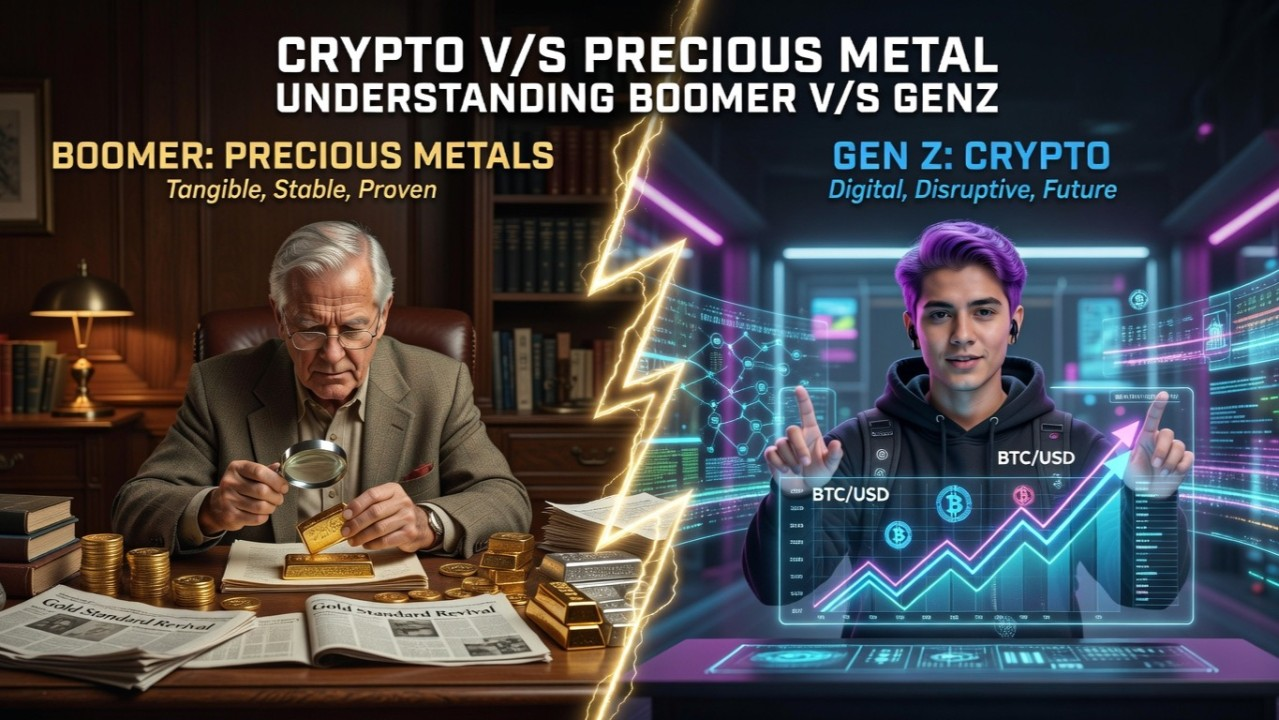
Gold vs. Crypto: The Wrong Question — and the Right One
SQOOT Pure Editorial · April 2026 · 6 min read
In many Asian — especially Indian — households, gold was never "old-fashioned." It was Stridhan: a practical way families protected a daughter's future and dignity across generations. Not a trade. Not a bet. A foundation.
Today, Millennials and Gen Z ask a fair question: if crypto is booming, why should I care about precious metals? It is a reasonable question. But it frames the two assets as competitors when they actually play entirely different roles.
Two Different Asset Roles
Gold behaves like a foundation asset. It is often held as a hedge when confidence in other systems drops. It is built on deep global liquidity, centuries of institutional use, and physical demand that exists outside of any single market or country. It does not promise extraordinary returns. It promises durability.
Bitcoin behaves more like a venture asset. It carries higher upside potential — and historically, much higher volatility. Major drawdown cycles exceeding 75–80% from peak to trough have occurred multiple times since Bitcoin's inception. For investors who can absorb that volatility and have a long time horizon, it may play a role. But it is not a foundation.
What the Research Shows
The World Gold Council's allocation studies argue that gold tends to reduce portfolio volatility more consistently than bitcoin. That is not a claim that gold outperforms bitcoin — it often does not, in bull cycles. It is a claim about what each asset does in a portfolio during stress periods.
The question is not which one is "better." The question is: what role does each play? A foundation protects the base. A venture position seeks outsized growth. Most serious long-term portfolios benefit from both — sized appropriately.
The conversation should not be "gold vs. crypto." It should be: what protects my base, and what grows my upside?
Why SQOOT Pure Focuses on the Foundation
SQOOT Pure is a digital-first, compliance-first platform for physical precious-metals ownership — built for long-term storage, gifting, and generational planning. Not for speculation. Not for price chasing.
If you are thinking about how to structure the base of your financial life — the part that holds its value when other systems are under pressure — that is the conversation SQOOT Pure is designed to support.
For your own strategy: what is your foundation asset today? Gold, index funds, real estate, or a mix? There is no single right answer. But it is worth asking the question deliberately — rather than defaulting to whatever is in the news.
This article is for educational purposes only. SQOOT Pure does not provide investment advice. Past performance of any asset class does not indicate future results. Gold and cryptocurrency are subject to price risk.